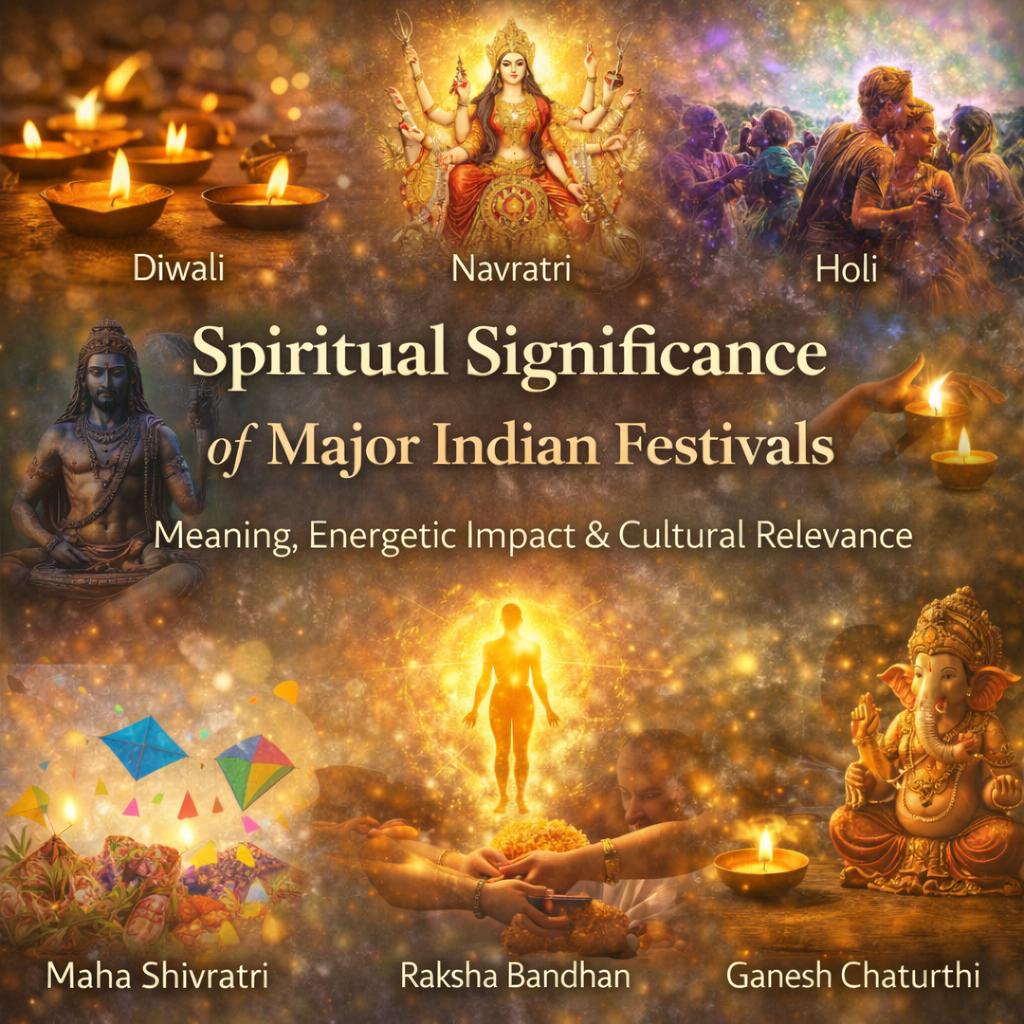
Spiritual Significance of Major Indian Festivals
A Deep Dive into Meaning, Energetic Impact & Cultural Relevance
Indian festivals are not merely celebrations or social events. They are energetic alignments with nature, cosmic cycles, and human consciousness. Each festival is timed, designed, and practiced to elevate collective energy, purify emotions, and bring balance to life.
In Sanatan Dharma, festivals act as spiritual checkpoints—moments where individuals and communities realign with higher awareness, seasonal shifts, and inner transformation.
This blog explores the spiritual significance of major Indian festivals, explaining why they exist, what energy they activate, and how they remain relevant today.
Why Festivals Hold Spiritual Power in India
Indian festivals are based on:
- Lunar and solar cycles
- Panchatatva (five elements)
- Psychological and emotional cleansing
- Collective consciousness upliftment
When millions perform the same rituals simultaneously, it creates a mass energetic resonance, amplifying individual benefits.
Festivals are spiritual technology in cultural form.
1. Diwali — Festival of Light & Inner Awakening
Spiritual Meaning
Diwali symbolizes the victory of light over darkness, knowledge over ignorance, and awareness over fear.
Lighting diyas is not symbolic alone—it represents awakening the inner jyoti (inner light).
Energetic Impact
- Fire element (Agni) purifies stagnant energy
- Homes are cleaned to remove old emotional residue
- Darkness is consciously replaced with illumination
Cultural Relevance
Diwali aligns individuals with fresh beginnings, clarity, and abundance—mentally and energetically.
2. Navratri — Activation of Shakti (Divine Feminine Energy)
Spiritual Meaning
Navratri honors Devi Shakti in nine forms, representing transformation of human tendencies:
- Fear → Strength
- Ego → Wisdom
- Ignorance → Awareness
Each day focuses on inner purification.
Energetic Impact
- Fasting lightens the body and sharpens awareness
- Chanting and dance (Garba) circulate energy
- Emotional and psychological detox occurs
Cultural Relevance
Navratri reconnects society with balance between power and compassion, especially relevant in modern times.
3. Holi — Emotional Release & Energy Reset
Spiritual Meaning
Holi signifies the burning of ego, resentment, and emotional baggage (Holika Dahan).
Playing with colors symbolizes equality and joy beyond identity.
Energetic Impact
- Emotional suppression is released
- Social barriers dissolve temporarily
- Laughter and play reset the nervous system
Cultural Relevance
In a stressed society, Holi acts as a collective emotional therapy.
4. Maha Shivratri — Inner Stillness & Consciousness Expansion
Spiritual Meaning
Shivratri is dedicated to Shiva tattva—pure consciousness and inner silence.
Staying awake symbolizes rising above unconsciousness.
Energetic Impact
- Planetary alignment supports meditation
- Spine (kundalini path) becomes receptive
- Stillness replaces mental chaos
Cultural Relevance
Shivratri reminds modern seekers that true power lies in inner silence, not constant action.
5. Makar Sankranti — Alignment with Solar Energy
Spiritual Meaning
Marks the Sun’s movement toward the northern hemisphere (Uttarayan)—symbolizing progress and awakening.
Energetic Impact
- Increased solar prana
- Seasonal depression naturally reduces
- Body adjusts to climatic shift
Cultural Relevance
Celebrates discipline, gratitude, and renewal, vital for physical and mental health.
6. Raksha Bandhan — Energetic Protection & Bonding
Spiritual Meaning
Raksha Bandhan is about energetic protection, trust, and responsibility, not gender roles.
The rakhi acts as a protective energy knot.
Energetic Impact
- Strengthens emotional security
- Reinforces supportive bonds
- Creates subtle protective intention
Cultural Relevance
In a fragmented world, Raksha Bandhan restores emotional connection and accountability.
7. Ganesh Chaturthi — Removal of Inner Obstacles
Spiritual Meaning
Lord Ganesha represents buddhi (intelligence) and obstacle removal.
Immersion (Visarjan) symbolizes letting go of attachments.
Energetic Impact
- Mental blocks dissolve
- New beginnings are energetically supported
- Ego structures soften
Cultural Relevance
Teaches problem-solving through wisdom, patience, and humility.
The Science Behind Festival Timings
Indian festivals align with:
- Moon phases affecting emotions
- Seasonal transitions affecting the body
- Agricultural cycles ensuring sustainability
This synchronization ensures maximum energetic benefit with minimal effort.
Why Modern Society Still Needs Festivals
In today’s fast-paced life:
- Emotional buildup is constant
- Community bonding is weak
- Inner reflection is rare
Festivals provide:
- Scheduled emotional release
- Collective joy and belonging
- Cultural grounding
- Spiritual reminders
They keep society psychologically and energetically balanced.
How to Celebrate Festivals Spiritually (Not Mechanically)
✔️ Understand the meaning
✔️ Perform rituals with awareness
✔️ Reduce excess consumption
✔️ Focus on inner alignment
✔️ Respect nature and tradition
Celebration without awareness becomes noise.
Awareness turns rituals into transformation.
Final Thoughts
Indian festivals are not relics of the past—they are living systems of spiritual wisdom. They help individuals reset, societies heal, and cultures stay rooted while evolving.
When celebrated consciously, festivals become powerful tools for inner growth, emotional balance, and energetic renewal.
At MysticEnerge, we believe festivals are reminders that life itself is sacred—and meant to be lived in harmony.